
An own cloud server gives your website what a web hosting company cannot: an account that belongs to your organization, a server that runs only your sites and full control over security, performance and data location. Not Without IT moves websites from GoDaddy, Bluehost, HostGator and other shared hosts to AWS, Microsoft Azure, Google Cloud or Oracle Cloud, and then we run the server for you.
Most small and medium-sized organizations rent their website space from a hosting company. It works, until it does not. For example, the site slows down because another customer on the same machine uses all the resources, an upsell appears for every basic feature, or the account belongs to a former employee. Meanwhile, the hosting company decides which PHP version, which database version and which security settings you get. With your own cloud server, you decide.
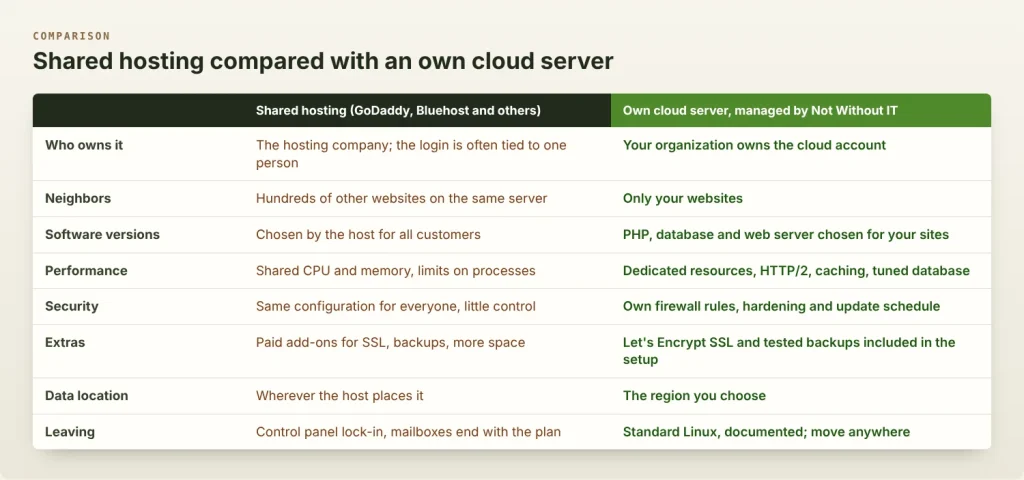
Shared hosting compared with an own cloud server
On shared hosting, hundreds of websites often share one server, one web server configuration and one set of limits. Therefore, a problem on another site can affect yours, and you cannot change the settings that matter. In contrast, a cloud server runs only your websites. You choose its size, its operating system and its software versions, and you can grow it in minutes.
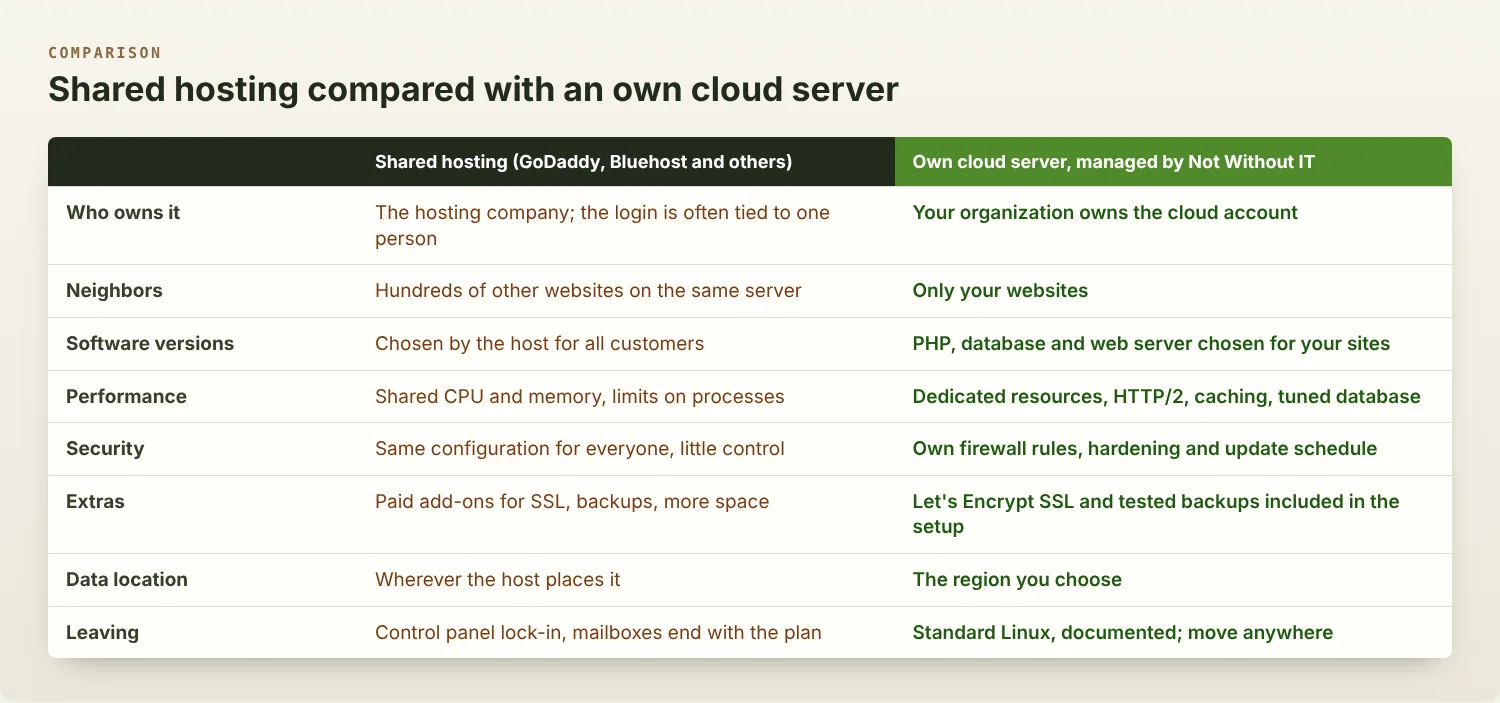
The differences show up in daily operations:
- Ownership: the cloud account is registered to your organization, so no hosting company or former agency stands between you and your website.
- Performance: dedicated CPU and memory for your site, with HTTP/2, compression and caching configured for your pages.
- Security: your own firewall rules, your own updates and no neighbors on the same server.
- Data location: you choose the region, for example a U.S. region for organizations with data residency requirements.
- Freedom: no upsells for SSL, backups or more space, and no lock-in to a control panel.
- Transparency: you pay the cloud provider directly for the resources you use.
In addition, several websites can share one server. Our own server, for instance, runs multiple websites, each with its own database and its own settings.
What we set up on your own cloud server
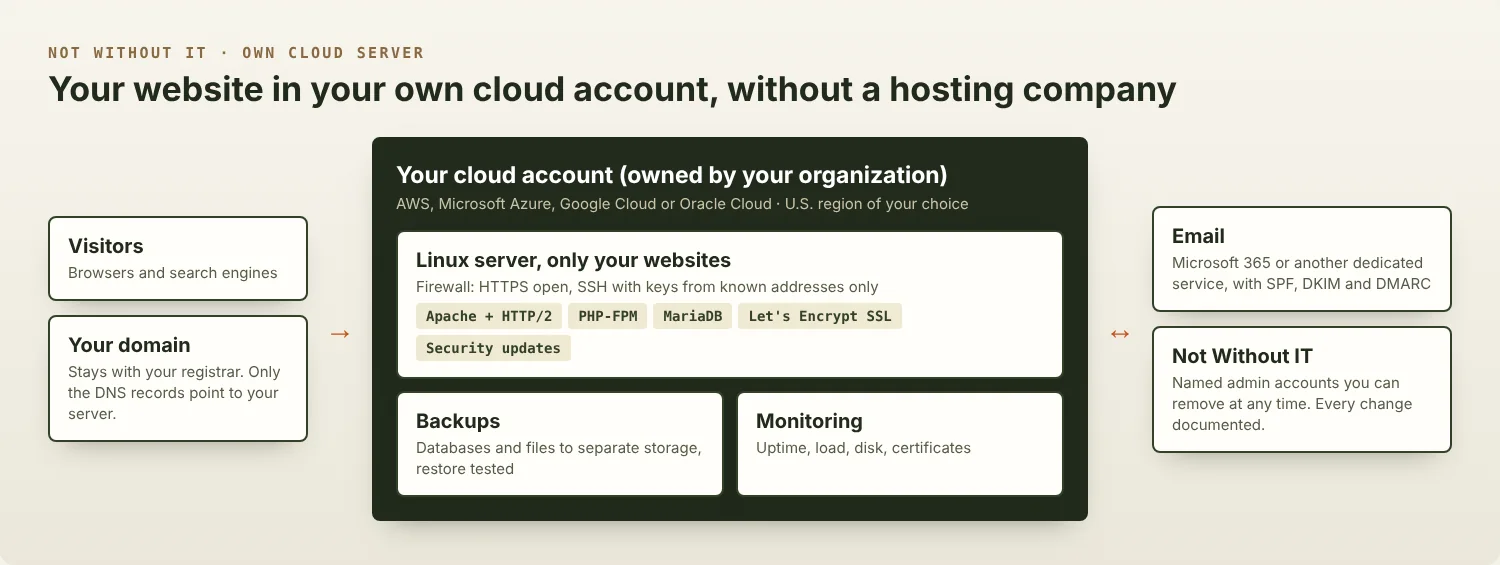
We build the server the same way we build our own. A typical setup includes:
- A Linux server, for example Amazon Linux, Ubuntu or Red Hat Enterprise Linux, sized for your traffic.
- Apache with HTTP/2, PHP-FPM and a MariaDB or MySQL database, configured and hardened by us.
- Free, automatically renewed SSL certificates from Let’s Encrypt.
- Automatic backups of files and databases to separate storage, with tested restores.
- Monitoring and alerts for uptime, CPU, disk space and certificate expiry.
- SSH access with keys only, firewall rules and no unnecessary services.
Read more about how we install and run the software on our page about web server management.
Moving from GoDaddy or another host to an own cloud server
A move follows a written plan. First, we take a full copy of your website and database from the current host. Next, we set up the new server, install the site and test it on a temporary address. After that, we lower the DNS time-to-live, switch the domain to the new server and check every page as an ordinary visitor. Finally, we keep the old hosting account until you confirm that everything works.
Email deserves special attention. Many hosting packages include mailboxes, and they disappear when the hosting ends. Therefore, we move your email to a dedicated service, for example Microsoft 365, before the switch. At the same time, we set up SPF, DKIM and DMARC, so your messages keep reaching their recipients. Our page about email security explains why that matters.
Which cloud platform fits your website
We work with all four major providers: Amazon Web Services, Microsoft Azure, Google Cloud and Oracle Cloud Infrastructure. Each of them offers virtual servers in U.S. regions, managed databases and storage for backups. Accordingly, we recommend a platform based on your existing agreements, your other systems and your budget. If your organization already uses Microsoft 365, for example, Azure can simplify billing and identity. Similarly, an existing AWS account makes Amazon Lightsail or EC2 a natural choice.
Price and how to get started
Setting up and moving your website to an own cloud server starts at $300 per hour, and we quote a fixed price after reviewing your current hosting. The cloud provider bills you directly for the server. Call (949) 355-1694, send a WhatsApp message or use the form below.
Frequently asked questions about an own cloud server
Own cloud server compared with web hosting
What is the difference between shared hosting and an own cloud server?
On shared hosting, many websites share one server and its limits. On your own cloud server, only your websites run, and you control every setting.
Why should I leave GoDaddy or another hosting company?
Mainly for control, performance and ownership. In addition, you avoid upsells and the hosting company’s limits.
Is an own cloud server more expensive than hosting?
Not necessarily. You pay the cloud provider for what you use, and one server can run several websites.
Who owns the cloud account?
Your organization does. We work in your account with our own accounts, which you can remove at any time.
Is my website faster on its own server?
Usually, yes. It gets dedicated resources, and we tune the web server and the database for your pages.
Is an own cloud server more secure than shared hosting?
Yes, when it is managed correctly. No other customers share the server, and we control the firewall, updates and access.
Can I run several websites on one cloud server?
Yes. For example, our own server runs multiple websites, each with its own database and settings.
Does an own cloud server have a control panel like cPanel?
It can, but we usually skip it. A control panel adds software to update, so instead we manage the server directly and document every change.
Can I choose where my data is stored?
Yes. You choose the region, for example a U.S. region close to your visitors.
Moving your website
Will my website go offline during the move?
Normally, no. We test the new server first and then switch the domain, so visitors move over gradually.
Can you move my WordPress site from GoDaddy?
Yes. We move WordPress, Joomla, Drupal and static sites from GoDaddy, Bluehost, HostGator and other hosts.
What happens to my email when I leave my hosting company?
Mailboxes in a hosting package end with the hosting. Therefore, we move your email to Microsoft 365 or another service first.
Do I have to move my domain name?
No. The domain can stay with your registrar, and we only change its DNS records.
Will my Google rankings change after moving to a new server?
No, as long as the addresses stay the same. In fact, a faster site often helps.
Do you keep the old hosting until everything works?
Yes. We cancel nothing until you confirm that the new server works.
Can you move my site from Wix or Squarespace to my own server?
Yes. However, those platforms do not export a full site, so we rebuild the design and move the content.
Running your own cloud server
Who updates the server?
We do. Our web server management covers updates for Linux, Apache, PHP and the database.
Do you make backups?
Yes. We back up files and databases to separate storage and test the restore regularly.
Do I get an SSL certificate?
Yes. We install free Let’s Encrypt certificates that renew automatically.
What happens if the server goes down?
Our monitoring alerts us, and we restore the service. In addition, a backup lets us rebuild the server quickly.
Do I need technical staff to run an own cloud server?
No. We run the server for you and document everything, so your organization keeps full insight.
Which cloud platform do you recommend?
It depends on your other systems. For instance, organizations with Microsoft 365 often choose Azure, while others choose AWS.
Can you set up a server at Oracle Cloud or Google Cloud?
Yes. We work with Oracle Cloud Infrastructure and Google Cloud as well as AWS and Azure.
Costs and working with us
How much does it cost to move my website to an own cloud server?
Our work starts at $300 per hour, and we quote a fixed price after a review of your current hosting.
Who pays the cloud provider?
You do, directly, so you always see what the server costs.
Do you offer monthly management of the server?
Yes. Monthly management covers updates, backups, monitoring and security checks.
Do you work with clients across the United States?
Yes. As a remote-first company, we set up and run servers for clients across the U.S.
Do you run your own website this way?
Yes. Notwithoutit.com runs on our own Linux server in the cloud, without a hosting company.
How do I get started?
Call (949) 355-1694 or use the form below, and tell us where your website is hosted today.
Why choose Not Without IT for your own cloud server?
We set up the server the way we run our own, we document everything and the account stays yours.